Author: Ian Murray

  • 5 ways to be more succinct when public speaking

    I admire people who can say things succinctly – speaking clearly, without rambling and without taking more time than their audience has.

    I imagine that comes from my own feelings of ineptitude, when hearing myself starting to repeat myself and searching for the elegant way to complete my point of view. You’ve probably had that same feeling – unsure whether you’ve covered the information clearly enough, only to carry on, and probably making what was a bad situation even worse.

    I’m learning that some myths underpin that approach:

    • Saying more, is necessarily helping more.
    • We need to read the minds of our audience, as to whether they understand enough or not.
    • The audience will distill what I am saying down to something they can use, using their own words.

    That’s right, these are NOT TRUE.

    As a speaker, our role is to COMMUNICATE – and that means, we should develop the skill to influence not only how the message leaves our bodies, but also how it is received by the audience. It is not unidirectional. It is not about us knowing our material. It is about finding the best way for the audience to receive the message in a way that is meaningful to them.

    I promised 5 ways that you can improve your ability to be succinct in your communications.

    1. Get quotable. Distill your information to short quotes that can be written down, used, and shared beyond the event. Of all the other things you say, you can make it clear that these are the take-outs.

    2. Use a Communication Framework – not too dissimilar to what Youarn mentions in the video. Try P-R-E-P. Deal with each piece of information that you want to communicate, by making your Point, providing Reasons, giving an Example, and making your Point even more succinctly (use your quote!). That might reduce your rambling!

    3. Slow down and Pause. Often the reason we aren’t succinct is because we say so much and our key message is lost in thousands of other words that just aren’t needed. Slow down, think ahead, and allow pauses to make your points “stick”.

    4. Ask questions. Remember that a presentation isn’t just one-way. Ask your audience for feedback as you go – little brings your answer closer to what your audience needs, than answering the questions they actually raise.

    5. Practice. Make a habit of summarising what you hear, so that you get better and better at distilling information to succinct messages.

    These might help you get better at sharing messages that have a greater impact with your audience.

    Love to know what you think!


  • How to Get Started on Blab – Video Livestreaming with blab.im

    If you’re reading this, you may have heard of the new Video Livestreaming platform called Blab. You may have seen a notification of an upcoming event with a link to an event that  has a url starting with http://blab.im/

    What is it?
    What do you do now?
    How do you attend the event?
    How do you participate, and get the most from it?

    Blab.im is a live-streaming video platform that allows users to host live video sessions with up to 4 people interacting on screen at the same time – and a very large number of viewers interacting from a chat box on the right hand side.  These sessions may be like meetings, discussions, or even presentations where people can engage directly and dynamically with the host(s) throughout the session!
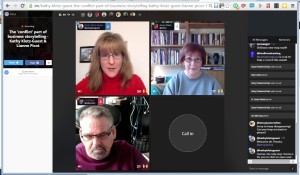
    Blab Screenshot_20151218

    Extremely easy to use, and accessible to almost  anyone in the world, Blab allows you to connnect with an international audience in a semi-casual setting – with many users attending from their home offices, or walking with their mobile devices – wherever they may be.

    Step 1. Access the blab.im platform

    Open a browser so that you  can access the internet. (At the time of writing Blab.im works well with Google Chrome and Firefox, to name some).

    To help maximise your ability to participate in the Blab, make sure you are logged in (creating an account if you haven’t already), to twitter.com.

    Once logged in to twitter, go to http://blab.im (or use the URL you were sent). If you haven’t been in before, you will be asked to log in to Blab.
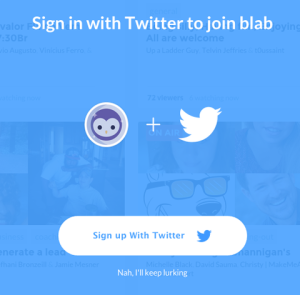
    blab-signinClick on the “Sign up with Twitter”, and an account will be created, so that you will be able to actively participate in a Blab. Blab will collect your profile information from Twitter, and populate your Blab profile from there.

    Step 2. Attend your first blab

    Believe it or not, you are ALREADY able to attend your first blab and participate actively in the session! Blab is remarkably simple to access, and provides a lot of functionality with very few gotchas that might impede your progress. Even then, if you do have issues, you can almost always find someone with a little more experience – willing to help you get started.

    Step 3. Engage in the Blab

    To participate in the conversation, there are only a handful of things you really need to know – and almost everything is accessible from the main screen of an active Blab.

    • You can type comments in the chat box on the right.
    • You can reply to others’ comments, by clicking on the small arrow to the right of their ‘names’.
    • You can ask questions from the chat box, starting your comment with “/Q” such as “/Q Do you know if that’s possible in Australia?”
    • You can view others’ profiles by clicking on their names, and “follow” people on Blab – or you can click through to their twitter profiles, and follow them there – and often find links to their websites to learn more about them.
    • You can share a link to the session to twitter or facebook, using the buttons on the left below the title of the blab, so that you can share with your network of people who may find the session valuable.

    Blab is a rich conversational platform where you can meet many people with whom you can develop contacts, friendships and business opportunities.

    Gotcha #1 – Delays, Echos and lost video connections

    Blab uses a number of technologies to bring this rich environment together, and each have their own complexities that they manage to give you a great experience.

    So long as you have a good backbone internet network, many can be overcome just be doing a “refresh” of your browser screen (F5 on many browsers). Wait for it to re-start, and connect with your current Blab, and you should find the session restored. Try 2 or 3 times, if you must. Most issues go away with a simple refresh.

    Gotcha #2 – Persistent echos or feedback

    With the delays that occur with sound travelling vast distances over the internet – and the interactions of sounds around your computer – sound can be distorted in many ways.

    When you attend a few blabs, you will notice that almost every person on Blab uses low-cost headphones to stop the sound reaching their microphone and affectig the sound quality. Invest in some headphones ($10-20 phone ear buds are adequate), and you will help you – and others – have a great experience on Blab.

    Gotcha #3 – Things change

    Blab is in beta, and the team at Blab are working hard to develop the platform to provide an even better experience for the community that are flocking to Blab. Over time, features change, shows come and go, and more and more people are becoming aware of the benefits of live streaming every day.

    The best thing is that we don’t all need to write articles like this, to help people find all the possibilities with Blab. There are some great articles and videos already out there that will help you get going. And there are expert co-hosts, who know the platform extremely well, who can work with you to make your experience an outstanding experience.

    Here are some related articles that will help you, or you can Contact Us to help with your plans to use Blab to grow your business. We’ll add some gems over time.

    15 Blab Tips for Marketers – Social Media Examiner’s Ultimate Guide to Blab


  • Quotable Content creates Memorable Moments

    Have you ever been to a presentation, and racked your brain to remember the three key points the presenter spoke about?

    Have you struggled to turn their suggestions into actions that you could take after the presentation?

    Have you heard an interesting phrase a presenter coined, but couldn’t remember it later?


    As an audience member, if you experience this, I’d say “It’s not your fault!”


    What if… Presenters made all these easy?


    If you want to make a presentation memorable, spend the time to create Quotable Content – sound bites that the audience can easily detect, digest, and document – there and then – to record your words.

    You know… famous quotes are famous… due largely to the fact that someone wrote them down. If no-one writes anything you say down, you are unlikely to become known for even the most genius of ideas!

    Next time you are planning a presentation, see if you can come up with Quotable Content that will stick. Look at your main points, and develop:-

    • pithy summaries of your key messages
    • succinct names for each idea you wish to share
    • clear actions your audience can apply

    Imaging your audience taking notes using a mindmap – and make your quotable content fit!

    Make it easy for your audience to detect, digest and document and tell them “write this down, it’s good!”… and you will stand half a chance, of them taking action on your message…

    .. and you might just become famous, too.


  • Persuasive Speaking using Munroe’s Sequence

    When we are speaking in public, whether in front of a room of people, or even in a one-on-one conversation, we’d all like to think that we are having some impact on our listeners!

    We might be trying to convince our work colleagues to go into the city fun run. We might be communicating our suitability for a job that we’ve applied for. We might be looking to convince our parents that it’s time to go into a nursing home.

    We are often persuading, or being persuaded.

    Wouldn’t it be useful to know how to do it well!


    Alan Munroe developed one technique for persuasive speaking, that is known as Munroe’s Motivated Sequence. In short, his sequence is:-

    1. Get the attention of the audience

    2. Show that there is a significant need for the solution that you offer

    3. Demonstrate that you can satisfy the need that you have identified

    4. Visualise the situation when the need is solved, with the audience

    5. Make the action clear, that the audience needs to take to utilise your solution.


    Once you’ve completed Munroe’s Sequence, the audience can easily see how you can solve their problem.

    That’s pretty persuasive!


    parents to go into a nursing home. We might be

    There are times, too, that what we are communicating is of great importance. We might be communicating in an interview in a hope to get a job.

  • How to use feedback to improve public speaking

    I was thinking about bookshops the other day. The ones that are surviving have niched! They have focussed on a particular area – it might be “tertiary education” – and considered how could they best serve their market in that niche. No only have they reflected on that area, and considered how, they’ve gone on to implement and to test how well that plan has performed. It’s like that in speaking!

    • Do you want to know what others think of your communication?
    • Do you know what to do with that feedback when you get it?
    • Do you want to get even more feedback that you can use to improve?

    Reginald Evans bucked the system of education, after exploring how people learnt when he encouraged managers at the Coal Board in the UK to meet together, to share their experiences and ask each other questions about what they saw and heard. When they applied the learning, the improved productivity was clearly evident – much better than much of the teaching that was going on at the time. Action Learning was born.

    As Evans put it,

    • Learning = Programming + Questioning

    =  (Programmed Knowledge with Simulations)  + (Insights on what people hear, see, feel)


    Michael Marquardt added an important element

    • Learning = Programming + Questioning + Reflection


    Reflection is also at the cornerstone in the art of coaching, where great questions can bring light to the insights where some of the greatest changes can be made. We’ll talk more about that in another post soon.

    So if we apply this in a powerful setting, where a small group looks to learn from each other, there really are…

    3 Simple Steps to Success in Speaking through Feedback

    1. Capture the presentation to study (it might be yours, it might be someone elses that you’d like to learn from). Use Video to capture it!
    2. Question and Reflect on how the presentation affected the audience. What might you do differently?
    3. Apply the learnings!

    … and make sure you’re starting at Step 1 again, to be ready to improve even more!

    Those 3 Simple Steps help you capture some great examples of communication, get more feedback than you can ever deduce yourself, and apply what you learn to improve! Pretty powerful stuff!

    We’ve just started a community, where we’ve brought some of this methodology from our client programmes out into the Social Media world. Go over and join in, at Critique My Speech.

    Lets hope the good bookshops keep Acting, Questioning, Reflecting and Learning!


  • Fear of Public Speaking – more than death?

    I am regularly reminded of the “statistic” that the majority of people have a fear of public speaking greater than that of death. Google leads me to Richard Garber’s analysis of the origins of the ‘research’.

    Published in ‘The Book of Lists’ of 1977, and probably originating from ‘What Are Americans Afraid Of’, The Bruskin Report, 53, July 1973, the claim has been reviewed many times – especially when most people who cite the statistic are frequently in the Public Speaking training industry.

    In the end, the specific proportion of fear and its relation to the perception of death is inconsequential….

    What matters, is how you approach the prospect of presenting in public!


    Like many of you, I’ve felt the headache the night before an important presentation, and the perspiration as the time approached to present my pitch. I look back now, and realise the chain of events. I could feel the stress, because I wasn’t prepared enough. I could hear the audience asking tough questions. I could see that I had gaps in my logic.

    Human behaviour consistently shows that when faced with something with which we are unfamiliar, we choose how we respond, based on whether we see it as an opportunity or as a challenge. We utilise a range of strategies to qualify and quantify what we face, and more strategies as we manage our progress towards or away from the event itself.

    Once we realise that, we can make different choices. We can modify our strategies, so that we can approach the event in a different way.


    Just think.. I could have prepared more thoroughly. I could have prepared answers for the questions that the audience could predictably ask. I could have ensured some of the audience were already on my side, before the actual presentation!

    I had a range of strategies that could have prepared me and my audience for a better outcome. All I needed to do, is consider them, and utilise those strategies rather than those that led me to experience the fear, risk the embarrassment and expose my weaknesses to the audience I would really have preferred to impress.

    What strategies do you use, when faced with a potential public speaking opportunity? How could you utilise better strategies to make your performance a memorable one – for the right reasons?


  • Hacked By Sxtz

    Hacked By Sxtz

    Hacked By Sxtz


    GreetZ : Prosox – Shade – N3X0000S
    Contact @KunSxtz

    Hacked By Sxtz